Hanbit Enterprises, Inc. dba Jack and the Beanstalk is recalling Soybean Sprouts in 1lb, 1.5lb, 10 lb, and Natto plastic bags distributed up to and including February 12, 2015 with Best if Used by dates up to February 19, 2015, because they have the potential to be contaminated with Listeria monocytogenes, an organism which can cause serious and sometimes fatal infections in young children, frail or elderly people, and others with weakened immune systems. Although healthy individuals may suffer long-­‐term symptoms such as high fever, severe headache, stiffness, nausea, abdominal pain and diarrhea, Listeriainfection can cause miscarriages and stillbirths among pregnant women.

The soybean sprouts were distributed to Bay Area stores and restaurants.

1LB SOYBEAN SPROUT BAR CODE – 7-27580-12366-9
1.5LB SOYBEAN SPROUT BAR CODE – 7-27580-12365-2
10LB SOYBEAN SPROUT BAR CODE – 7-27580-12351-5
NATTO SOYBEAN SPROUT BAR CODE – 7-27580-12367-6

No illnesses that have been reported to date.

The recall was the result of a routine sampling program by the FDA which revealed that the finished products contained the Listeria bacteria. The company has ceased the production and distribution of the product as FDA and the company continues their investigation as to what caused the problem.

CDC collaborated with public health officials in several states and with the U.S. Food and Drug Administration (FDA) to investigate an outbreak of Listeria monocytogenes infections (listeriosis). Joint investigation efforts indicated that commercially produced, prepackaged caramel apples made from Bidart Bros. apples were the likely source of this outbreak.

Public health investigators used the PulseNet system to identify illnesses that were part of this outbreak. PulseNet is the national subtyping network of public health and food regulatory agency laboratories coordinated by CDC. DNA “fingerprinting” is performed on Listeria bacteria isolated from ill people using techniques called pulsed-field gel electrophoresis (PFGE) and whole genome sequencing (WGS).

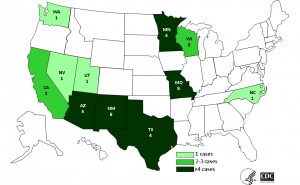
The 35 ill people included in this outbreak investigation were reported from 12 states: Arizona (5), California (3), Colorado (1), Minnesota (4), Missouri (5), Nevada (1), New Mexico (6), North Carolina (1), Texas (4), Utah (1), Washington (1), and Wisconsin (3). Illness onset dates ranged from October 17, 2014, to January 6, 2015. Eleven illnesses were associated with a pregnancy (occurred in a pregnant woman or her newborn infant). One fetal loss was reported. Among people whose illnesses were not associated with a pregnancy, ages ranged from 7 to 92 years, with a median age of 62 years, and 33% were female. Three invasive illnesses (meningitis) occurred among otherwise healthy children aged 5–15 years. Thirty-four people were hospitalized, and listeriosis contributed to at least three of the seven deaths reported.

The Public Health Agency of Canada (PHAC) identified two cases of listeriosis in Canada with the same PFGE patterns as those seen in the U.S. outbreak. More detailed testing using WGS showed that the isolate from only one of the two cases was genetically related to the U.S. outbreak. That person reported eating a caramel apple.

On January 6, 2015, Bidart Bros. of Bakersfield, California, voluntarily recalled Granny Smith and Gala apples because environmental testing revealed contamination with Listeria monocytogenes at the firm’s apple-packing facility. The recall included all Granny Smith and Gala apples shipped from its Shafter, California, packing facility in 2014. On January 8, 2015, FDA laboratory analyses using PFGE showed that environmental Listeria isolates from the Bidart Bros. facility were indistinguishable from the outbreak strains. On January 18, 2015, WGS found that these isolates were highly related to the outbreak strains. In addition, WGS showed that Listeria isolates from whole apples produced by Bidart Bros., collected along the distribution chain, also were highly related to the outbreak strains.

Three firms that produce caramel apples issued voluntary recalls after receiving notice from Bidart Bros. that there may be a connection between Bidart Bros. apples and this listeriosis outbreak. On December 24, 2014, Happy Apple Company of Washington, Missouri, voluntarily recalled Happy Apples brand caramel apples with a best use by date between August 25 and November 23, 2014. On December 31, 2014, Happy Apple Company expanded the recall to include Kroger brand caramel apples produced by Happy Apple Company with a best use by date between September 15 and November 18, 2014. On December 27, 2014, California Snack Foods voluntarily recalled Karm’l Dapple brand caramel apples with a best use by date between August 15 and November 28, 2014. On December 29, 2014, Merb’s Candies of St. Louis, Missouri issued a voluntary recall of Merb’s Candies Bionic Apples and Double Dipped Apples that would have been available from September 8 through November 25, 2014.

Korean Food Co. of Irving Texas is recalling 8 boxes of (20 bag in each box) Go-Hang Soybean sprouts in 1 lb. and 2 lb. bags distributed Jan 30, 2015 – Feb 6, 2015 because they have the potential to be contaminated with Listeria monocytogenes, an organism which can cause serious and sometimes fatal infections in young children, frail or elderly people, and others with weakened immune systems. Although healthy individuals may suffer only short-term symptoms such as high fever, severe headache, stiffness, nausea, abdominal pain and diarrhea, Listeriainfection can cause miscarriages and stillbirths among pregnant women.

The soybean sprouts were distributed to KO-MART in Dallas and H-MART in Plano and Carrollton retail stores in Texas.

1LB SOYBEAN SPROUT BAR CODE- 4205312100
2LB SOYBEAN SPROUT BAR CODE- 42053-13650

No illnesses that have been reported to date.

The recall was the result of a routine sampling program by the FDA which revealed that the finished products contained the bacteria. The company has ceased the production and distribution of the product as FDA and the company continues their investigation as to what caused the problem.
Queseria Bendita LLC of Yakima, Washington is recalling all lots of Panela, Queso Fresco, Requeson, Cotija fresh soft cheese products and Sour Cream to include ALL Best By Dates because of a potential to be contaminated with Listeria monocytogenes, an organism which can cause serious and sometimes fatal infections in young children, frail or elderly people, and others with weakened immune systems. Although healthy individuals may suffer only short-term symptoms such as high fever, severe headache, stiffness, nausea, abdominal pain and diarrhea, listeria infection can cause miscarriages and stillbirths among pregnant women.

Panela, Queso Fresco, Requeson, Cotija fresh soft cheese products and Sour Cream were distributed to Hispanic grocery stores in Washington and Oregon and the firm also sold products from its on-site store in Yakima, Washington.

The recalled products are packaged with clear plastic wrapper or plastic tub, and the best by dates are stamp coded next to a label. The products are refrigerated and have the shelf life of up to 90 days. The last date of distribution of recalled products is January 15, 2015.

Up to date, there are a total of three (3) cases of Listeria monocytogenes infections linked to consumption of soft cheese produced by Queseria Bendita, including two hospitalizations and one death.

The recall was the result of the investigation and samples collection by the Food and Drug Administration. The company has currently agreed to cease the production and distribution of all products.

Inventure Foods, Inc. of Phoenix, Arizona, has issued a precautionary recall of its RADER FARMS® Fresh Start Smoothie Blend, Fresh Start Sunrise Refresh Fusion, and Fresh Start Daily Power Fusion because of a potential to be contaminated with Listeria monocytogenes, an organism which can cause serious and sometimes fatal infections in young children, frail or elderly people, and others with weakened immune systems. Although healthy individuals may suffer only short-term symptoms such as high fever, severe headache, stiffness, nausea, abdominal pain and diarrhea, listeria infection can cause miscarriages and stillbirths among pregnant women.

These recalled blends themselves did not test positive for Listeria monocytogenes. However, Listeria monocytogenes was detected on spinach and/or kale ingredients on another lot which is currently placed on hold. These spinach and kale ingredients used to manufacture the recalled blends were supplied by the same outside party.

Fresh Start Smoothie Blend is distributed in 48 oz. (3 lbs.) packages at Costco in Alaska, Arizona, California, Colorado, Idaho, Montana, Nevada, New Mexico, Oregon, Utah, Washington, and in Alberta, British Columbia, Manitoba, and Saskatchewan of Canada.

The Fresh StartSunrise Refresh Fusion and Fresh StartDaily Power Fusion products are distributed in 35 oz. packages at Walmart in Alaska, Arizona, California, Colorado, Idaho, Montana, Nevada, New Mexico, Oregon, Texas, Utah, Washington, and Wyoming.

The packages carry the Rader Farms and Fresh Start logos and are sold in the frozen fruit aisle of the store.

Washington State health and agriculture officials are working with the Centers for Disease Control and Prevention and the U.S. Food and Drug Administration on an ongoing outbreak of Listeria monocytogenes infections linked to consumption of Latin-style soft cheese produced by Queseria Bendita, a Yakima, Washington firm.

As of January 16, 2015, a total of three cases have been identified from Washington in King, Pierce and Yakima counties. One illness was pregnancy-associated, two people were hospitalized and one death was reported. The affected products made by the Yakima-based Queseria Bendita are subject to a voluntary recall and the firm has stopped producing cheese.

Health officials are warning consumers who may have purchased these three Queseria Bendita brand cheeses: Queso Fresco, Panela, and Requeson and still have it in their refrigerators to throw the product away and not eat it. Grocery stores and distributors should pull and not sell these products.

Listeriosis is a serious infection caused by eating food contaminated with the bacterium Listeria monocytogenes. The disease affects primarily older adults, pregnant women, newborns, and persons with weakened immune systems. Approximately 11 to 29 cases of listeriosis are reported in Washington each year.

Symptoms of listeriosis include fever, muscle aches, headache, stiff neck, confusion, loss of balance, and convulsions. Blood stream infections or meningitis may occur. Infected pregnant women may experience only a mild, flu-like illness; however, infections during pregnancy can lead to miscarriage or stillbirth, premature delivery, or infection of the newborn. Symptoms often begin three weeks after infection, but it could take anywhere from three to 70 days.

Happy Apples is expanding their voluntary recall of caramel apples to include Kroger Brand caramel apples produced by Happy Apple Company with a best use by date between September 15th and November 18th 2014, because it has the potential to be contaminated with Listeria monocytogenes.

Kroger brand caramel apples produced by Happy Apple Company are sold in single packs and three packs and each package will have a best use by date on the front of the label. They were distributed to the following states: Arizona, Alaska, Kansas, Idaho, Louisiana, Montana, Missouri, Nebraska, Nevada, Oregon, Texas, Utah, Washington and Wyoming.

We have been working with the Food and Drug Administration in their investigation of the current outbreak of Listeriosis which has been associated with caramel apples. We recently received notice from Bidart Brothers, one of our apple suppliers to our California facility that there may be a connection between this outbreak and the apples that they supplied to that facility.

Listeria monocytogenes is an organism which can cause serious and sometimes fatal infections in young children, frail or elderly people, and others with weakened immune systems. Although healthy individuals may suffer only short-term symptoms such as high fever, severe headache, stiffness, nausea, abdominal pain and diarrhea, Listeria infection can cause miscarriages and stillbirths among pregnant women.

Happy Apples ceased operations at the end of October as part of our normal, seasonal shut down and the caramel apples produced are no longer available in stores, however, out of deep concern for public safety, we are recommending that consumers follow the advice of the CDC and remove any caramel apples you may have in storage and dispose of them in a secure container to avoid potential contamination in animals.

The CDC reports this morning that as of December 30, 2014, a total of 32 people infected with the outbreak strains of Listeria monocytogenes have been reported from 11 states: Arizona (4), California (2), Minnesota (4), Missouri (5), Nevada (1), New Mexico (6), North Carolina (1), Texas (4), Utah (1), Washington (1), and Wisconsin (3). Dates when the Listeria strains were isolated range from October 17, 2014, to December 11, 2014. Ten illnesses have been associated with a pregnancy (occurred in a pregnant woman or her newborn infant). One fetal loss has been reported. Among people whose illnesses were not associated with a pregnancy, ages ranged from 7 to 92 years, with a median age of 66 years, and 32% were female. Three invasive illnesses (meningitis) occurred among otherwise healthy children aged 5–15 years. Thirty-one ill people have been hospitalized and six deaths have been reported. Listeriosis contributed to three of these deaths, and it is unclear whether it contributed to an additional two deaths. The sixth death was unrelated to listeriosis.

The Public Health Agency of Canada (PHAC) has identified 2 cases of listeriosis in Canada with the same PFGE patterns as seen in the US outbreak.  PHAC is working with its provincial and territorial partners to determine the source of these illnesses.

From an FDA Christmas Eve Recall Notice:  Happy Apples, is issuing a voluntary recall of Happy Apple Brand caramel apples with a best use by date between August 25th and November 23rd 2014, because it has the potential to be contaminated with Listeria monocytogenes, an organism which can cause serious and sometimes fatal infections in young children, frail or elderly people, and others with weakened immune systems. Although healthy individuals may suffer only short-term symptoms such as high fever, severe headache, stiffness, nausea, abdominal pain and diarrhea, Listeria infection can cause miscarriages and stillbirths among pregnant women.

Happy Apple caramel apples are sold in single pack, three packs, four packs and eight packs and each package will have a best use by date on the front of the label. They were available for retail sale through grocery, discount and club stores, generally in the produce section and were distributed to retailers in the following states: Alabama, Arizona, Arkansas, California, Colorado, Florida, Georgia, Hawaii, Illinois, Indiana, Iowa, Kansas, Louisiana, Massachusetts, Minnesota, Mississippi, Missouri, Montana, Nebraska, Nevada, New Mexico, North Carolina, Ohio, Oklahoma, Oregon, Pennsylvania, Tennessee, Texas, Utah, Washington, Wisconsin.

As has been reported in the news, the Center for Disease Control has noted 29 illnesses in 10 states linked to the outbreak and they have advised consumers not to eat commercially produced, pre-packaged caramel apples until more is known.  Canada has also reported to likely Listeria illnesses.

Yesterday, Snoqualmie Gourmet Ice Cream, Inc. issued a voluntary recall of all ice cream, gelato, custard and sorbet for all flavors and container sizes produced on or after January 1, 2014 until December 15, 2014 because these products have the potential to be contaminated with Listeria monocytogenes.

The voluntary recall was initiated based on the confirmation positive result of Listeria monocytogenes in the samples collected within the production facility and analyzed by Washington State Department of Agriculture (WSDA).  However, today the Washington State Department of Health (WSDH), confirmed that at least two people – both men in their 50’s have been hospitalized in Seattle with Listeria infections linked to the recalled ice cream.

The ice cream, gelato, custard and sorbet were distributed in Arizona, Idaho, California, Oregon, and Washington may have been further distributed and sold in various retail outlets in Alaska, Colorado, Montana, Nevada, New Mexico, North Dakota, Texas, Utah, and Wyoming.

The products are labeled Snoqualmie Ice Cream, Snoqualmie Gelato, Snoqualmie Custard, Snoqualmie Sorbet or Emerald & Spruce Ice Cream or Top Pot Hand Forged Ice Cream and have a production date code located on the bottom of the container.  The date codes included either end in “4”, e.g. XXX4 (pints and cups) or are listed by date: January 1, 2014 through December 15, 2014 (trays & tubs).